


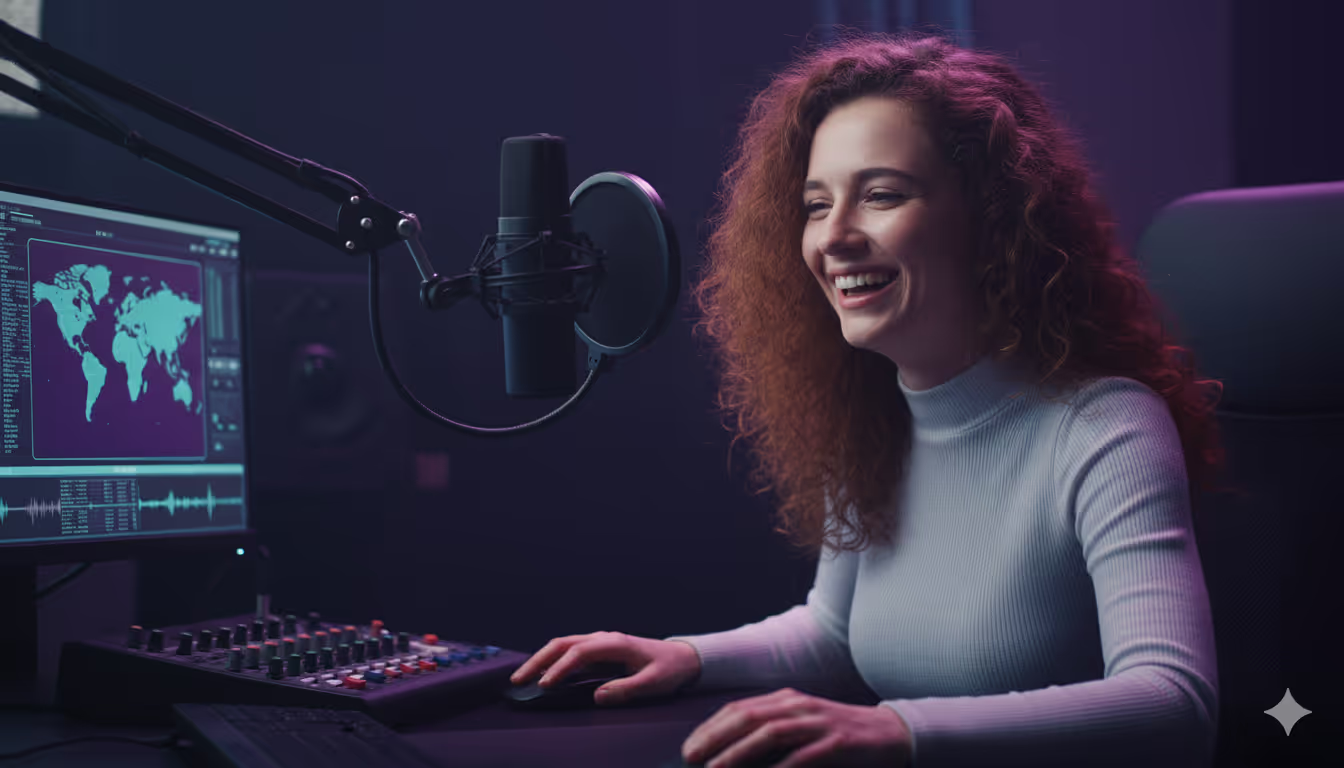
Have you ever watched a dubbed video where the original creator looks like they’re having the time of their life, but the translated voiceover sounds like a bank teller reading a foreclosure notice? It’s painful. It’s the audio equivalent of watching a movie with the sync off by three seconds.
(We’ve all closed that tab immediately.)
The traditional solution to this problem is a logistical nightmare. You have to book a high-end studio, hire a voice actor—who hopefully isn't recovering from a cold—and pay a production director to referee the whole thing. It’s a process that burns through your budget faster than you can say "localization," and it forces you to spend hours managing people when you should be making content.
As creators, we know the struggle. You want the world to hear you, but you don't have the patience to coordinate a multinational production team just to get your latest YouTube video into Portuguese. GoodDub was built because we got tired of the "expensive or terrible" ultimatum.
Let’s talk about workflow efficiency. In the legacy model, once your edit is locked, you’re looking at a multi-week turnaround for localization. You’re exporting assets, emailing large files, waiting for recording sessions, and dealing with revision cycles that feel endless.
AI-powered dubbing radically compresses this timeline. We are moving from weeks to minutes.
High fidelity usually comes with a high price tag. Historically, if you wanted quality, you paid for human talent. If you wanted cheap, you got robotic text-to-speech that ruined your engagement metrics.
GoodDub changes the ROI calculation. We decouple quality from manual labor. Once the core voice profile is generated, the marginal cost of adding a second, third, or tenth language drops significantly. You are essentially scaling your content asset without scaling your overhead. By eliminating studio rentals and booking fees, you regain control over your budget, allowing you to allocate those funds back into production.
Consistency is a vital metric for brand trust. If your US content sounds authoritative, but your Spanish dub sounds hesitant or generic, you fracture your brand identity.
GoodDub ensures your "sonic brand" remains stable. Our algorithms are tuned to recognize and replicate regional nuances. For instance, there is a massive linguistic difference between Peninsular Spanish and Latin American Spanish. A generic model mixes them up; our system distinguishes these dialects to ensure the dub sounds native to the specific region.
By preserving the original speaker's fundamental tone and rhythm, we ensure that your brand voice is the constant variable, regardless of the language being spoken.
Early AI voice models sounded flat because they flattened the audio spectrum—they stripped out the breath, the pauses, and the dynamic range.
We focus on Emotional Mapping. The technology has evolved to the point where we can mirror the emotional data of the source file. If your original video has high energy and fast pacing, the output matches that velocity. If the scene is somber, the AI modulates the pitch to match.
Whether the viewer is in Mexico City or Madrid, they aren't just hearing words; they are hearing your intent. We keep the human element in the loop without the manual labor.
The math is simple. The media landscape is global, but your time is finite.
Sticking to manual dubbing processes is a choice to limit your total addressable market. It keeps your content locked in a single region while your competitors expand. GoodDub allows you to bypass the logistical friction and go straight to market saturation.
This is about treating your content as a global asset rather than a local one. Your message needs to be understood and felt, not just translated.
Stop wasting billable hours on logistics.
Ready to scale? Let's make your voice heard.


